Social Media Automation: The Ultimate Guide to Reclaiming Your Time
Discover how social media automation can reclaim your time, boost engagement, and scale your brand's presence. Start working smarter, not harder, today.
23 min read
February 11, 2026
Let’s be honest: managing social media feels like a hamster wheel you can’t get off. You’re endlessly juggling posting schedules, deciphering metrics, and trying to engage with a never-ending stream of comments and messages. Social media automation is your escape plan. It's about teaching smart software and AI to handle the repetitive, time-sucking tasks for you.
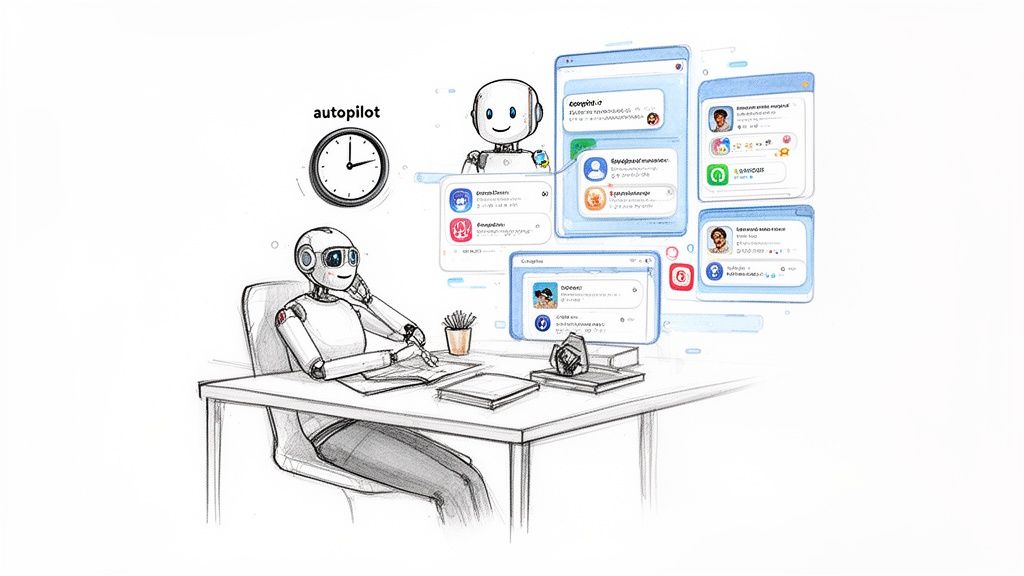
Imagine hiring a brilliant, tireless assistant who works 24/7. This assistant schedules your posts for peak engagement, analyzes what's working (and what's not), and even manages routine interactions, all without you lifting a finger. This isn't a fantasy—it’s how you keep your brand consistently active and growing, even while you’re sleeping, in a meeting, or finally taking a vacation.
Your New Reality With Social Media Automation
Picture this: you wake up, and your social media has been working for you all night. Your accounts are actively growing and engaging your audience while you focus on the big-picture strategy. Your content calendar is full for the next month, every post is scheduled to go out at the perfect time to maximize reach, and a beautiful report with clear insights is already waiting in your inbox. This isn't science fiction; it's the dream of social media automation made real.
Now, contrast that with the manual grind you know all too well. The soul-crushing loop of logging into five different platforms, frantically trying to write a post on the fly, scheduling them one by painful one, and struggling to reply to every last comment. It's a massive drain on your most valuable resources: your time and your energy.
The True Cost of Manual Management
The hours you lose to manual social media tasks add up fast. Every platform needs its own posting, replies and reporting. If you’re on four networks, that time multiplies—lost to clicking, typing, and uploading.
But the real cost isn't just the time; it's the lost opportunity. Imagine what you could do with that time back. Every hour spent on routine tasks is an hour you could have invested in designing a killer campaign, building relationships with high-value customers, or simply thinking creatively.
Automation flips that script entirely. It’s how you buy back those lost hours and finally focus on the work that actually grows your business.
The table below shows the difference between the old way and the new. The hours are rough illustrations, not measured data.
Activity
Manual Approach (The Grind)
Automated Approach (The Dream)
Content Scheduling
1-2 hours daily. Log in, upload, and schedule posts across each platform individually.
15 minutes daily. Imagine bulk uploading a month's worth of content and having an AI schedule it all for optimal times with one click.
Performance Tracking
2-3 hours weekly. Manually pull data from each platform into a spreadsheet for analysis.
Instant. Wake up to automated reports in your inbox, with key insights and trends already highlighted for you.
Audience Engagement
1-2 hours daily. Constantly monitor notifications and manually reply to common questions.
20 minutes daily. An AI assistant instantly answers common queries like "Where are you located?" while flagging only the most important conversations for your review.
Content Creation
5-10 hours weekly. Brainstorm, write, and design every single post from scratch.
1-2 hours weekly. Give an AI a link to your latest blog post, and watch it generate five different tweet ideas, a LinkedIn summary, and a video script in seconds.
Total Time/Week
~25 hours
~5 hours
Seeing it laid out like that makes the choice pretty clear, doesn't it? The automated approach isn't about being lazy; it's about being a strategic genius.
Embracing the Automated Dream
Let's go back to that ideal scenario. Imagine an AI assistant that finds viral-worthy articles in your niche and drafts posts about them while you sleep. Another tool automatically turns your customer testimonials into slick, engaging quote graphics. A third bot instantly answers routine Instagram DMs, freeing your team to handle only the most complex customer issues. This is exactly what modern social media automation does.
It’s not about removing the human element. It's about magnifying its impact.
By automating the routine, you free up your team to be more creative, more strategic, and to build the genuine human connections that bots can't.
This guide is your map to a new way of working. Forget burnout. Think of automation as your secret weapon for building a powerhouse online presence without draining your time and budget. It’s about giving yourself the freedom to scale your business in an incredibly crowded space.
How Automation Can Revolutionize Your Social Media Game
Think of running your social media accounts manually. It feels a bit like trying to fill a swimming pool with a teacup—a post here, a reply there. It’s slow, exhausting work. Social media automation is like turning on a fire hose. It gives you the power, speed, and intelligence to make a huge impact without burning yourself out.
This isn't just about saving a few minutes. It’s a complete transformation, turning your social channels from a daily chore into a reliable, automated growth machine for your business.
Let’s dig into the four core benefits that make this dream possible.
Build Rock-Solid Consistency
On social media, consistency is king. When your audience knows you’ll be there with great content, day in and day out, they become loyal fans. Automation makes achieving this effortless.
Forget the daily panic of "What should I post today?" Imagine sitting down on a Monday morning and scheduling out your content for the entire month in one go. Your posts will go live at the perfect moment—whether that's 3 AM on a Saturday or during a national holiday—keeping your brand top-of-mind 24/7. That kind of relentless presence is almost impossible to achieve by hand.
It’s like a hit TV show. Fans tune in every week because they know a new episode is coming. Automation creates that same predictable rhythm for your brand, building a loyal community that actually looks forward to what you have to say.
This constant activity sends a powerful signal to both platform algorithms and real people that you're a serious, authoritative voice in your industry.
Get Smarter with Audience Insights
Are you just throwing content at the wall and hoping it sticks? Flying blind is a great way to waste time and money. Automation swaps guesswork for hard data, using AI to listen to online conversations, spot engagement patterns, and catch trends before they explode.
Imagine having a 24/7 market research team that never sleeps. For example, it could analyze thousands of comments and tell you that your audience is suddenly buzzing about a new competitor, giving you the chance to react instantly. It combs through mountains of data to show you which posts are driving sales, what topics get the most shares, and how people really feel about your brand. Armed with that knowledge, every piece of content you create is a better-informed bet.
Scale Your Engagement Without Scaling Your Team
As your following grows, so does the flood of comments, DMs, and mentions. Trying to keep up manually is a recipe for disaster. Automation lets you handle that volume with grace, giving every person a stellar experience without hiring an army of community managers.
AI-powered chatbots can be your frontline support team. They can provide instant answers to common questions, flag urgent issues for a human, and even moderate comments to keep your community positive. This makes every follower feel seen. For example:
Instant Answers: An AI can handle "What are your business hours?" or "Do you ship to Canada?" in the blink of an eye, delighting customers with immediate support.
Lead Spotting: Imagine an AI that automatically detects comments like "How much is this?" and instantly sends that person's details to your sales team as a hot lead.
Sentiment Analysis: These tools can analyze the overall mood of brand mentions, giving you a heads-up on a potential PR crisis before it goes viral.
That kind of hyper-responsive engagement builds massive trust and goodwill, turning casual followers into your biggest advocates.
Boost Your Return on Investment (ROI)
Ultimately, your social media efforts have to make you money. Automation forges a direct link between your social activity and real-world results, turning your channels into powerful lead-generation machines.
But the biggest win? Time. Automation liberates your team from drudgery: content gets made faster, and repetitive tasks come off their plates.
When you let automation handle the mundane tasks, your team can finally focus on what humans do best: strategic thinking, relationship building, and creative innovation. That shift doesn't just make work more enjoyable; it puts your team's hours where they earn the most.
Building Your Automated Social Media Machine
Imagine assembling your own digital marketing dream team—one that works tirelessly around the clock to build your brand. That's exactly what building a social media automation workflow is like. It’s not about finding a single magic tool, but about connecting a series of smart components into a powerful, self-sustaining machine that prints results.
Each piece handles a specific job, and when they work in harmony, they create a seamless system that frees you to think about the big picture. This isn't just theory; it's how many marketing teams already use AI, from brainstorming to analytics.
So, let's look under the hood and see what makes this machine tick.
The Content Creation Engine
First up is the heart of your operation: the content engine. This is where AI transforms a blank page into a relentless stream of engaging posts. Forget staring at a blinking cursor, wondering what to write. Your automated engine finds the inspiration and crafts the content for you.
A powerful content engine automates two critical jobs:
Content Curation: Imagine an AI assistant that scans the web 24/7 for trending articles and viral conversations in your industry. It acts like your personal trend-spotter, delivering a daily digest of share-worthy material so you never run out of amazing things to post.
Content Generation: Once you have an idea, AI tools can generate multiple post variations in seconds. For example, give it a link to your latest case study, and it can instantly write a punchy Twitter thread highlighting the key results, an insightful LinkedIn post for industry leaders, and a compelling Facebook caption with a clear call-to-action. All in the time it takes to make a coffee.
The Smart Scheduling Hub
With your content ready, the next piece is the scheduling hub. Think of this as the strategic brain of your operation, ensuring every post goes out at the precise moment it will create the most impact. It’s about achieving maximum visibility with zero effort.
This hub is more than a simple timer. Modern tools like Buffer or Hootsuite suggest the best times to post; Hootsuite bases its suggestions on when your followers are most active (both checked October 7, 2026). You schedule posts for those windows, without manual guesswork.
This component is the secret to achieving the relentless consistency that algorithms and audiences crave, keeping your brand visible and top-of-mind.
The Automated Engagement Responder
An active social media presence generates a ton of conversation. The engagement responder is your frontline support, ensuring no follower feels ignored while filtering out the noise so you can focus on what matters.
Think of it as a smart receptionist for your social accounts. It can:
Provide Instant Answers: Automatically reply to common questions like "What are your hours?" or "Do you ship to Canada?", delivering perfect customer service instantly.
Moderate Comments: Automatically hide spam or inappropriate comments, keeping your community a safe and positive space for everyone.
Flag High-Priority Messages: Imagine it identifying messages with keywords like "complaint," "issue," or "purchase" and immediately alerting a human team member to provide a personal touch.
This allows your engagement to scale effortlessly as your audience grows, ensuring you always provide an exceptional experience.
The Performance Analytics Dashboard
Finally, no machine is complete without a dashboard to track performance. An automated analytics dashboard pulls all your key metrics into one place, giving you a crystal-clear, data-backed view of what's working—and what isn't.
Instead of spending hours manually compiling spreadsheets, you get beautiful, automated reports delivered straight to your inbox. These dashboards can track everything from engagement rates and follower growth to website clicks and sales conversions, presenting the insights in easy-to-read charts that tell you exactly what to do next.
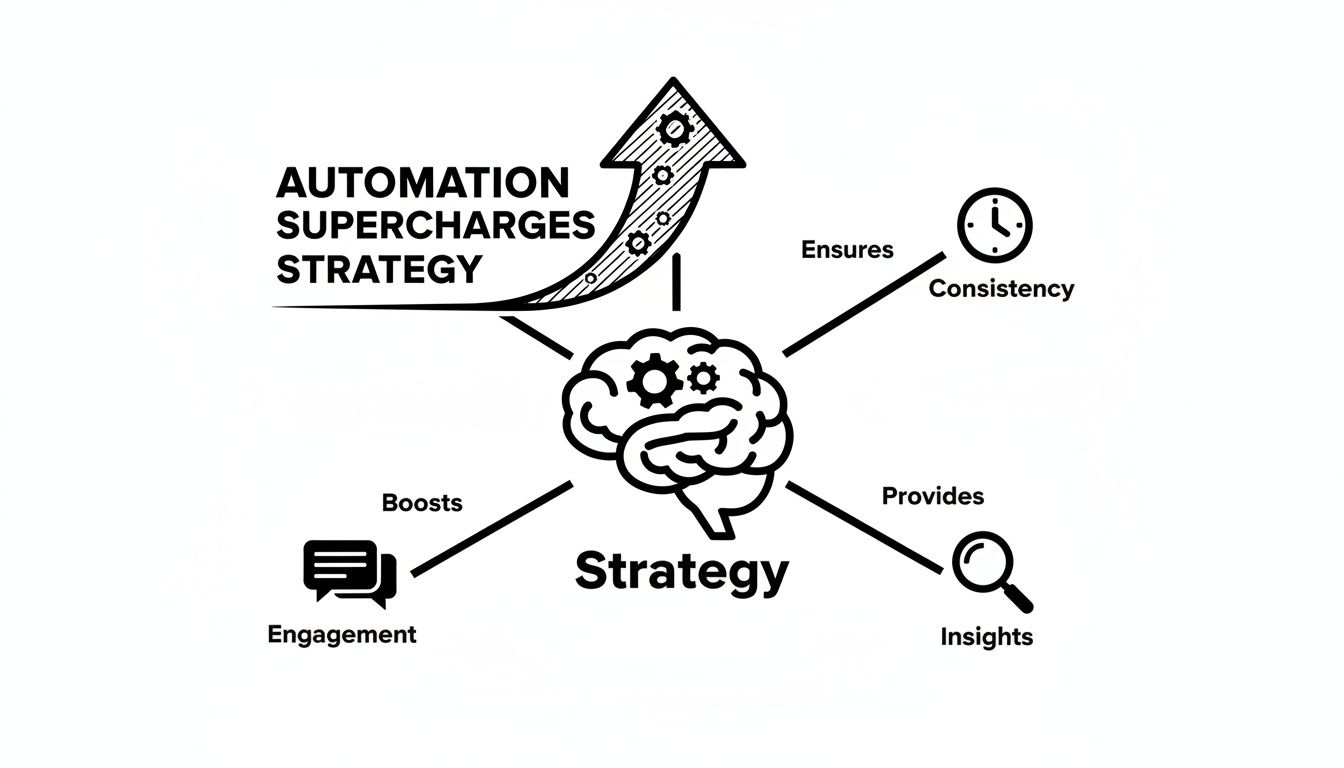
The diagram below shows how these core automation functions—consistency, engagement, and insights—all feed back into a stronger, more effective overall strategy.
As you can see, each element reinforces the others. It creates a powerful cycle of continuous improvement that pushes your social media presence forward with minimal manual effort.
Your Social Media Automation Toolkit
To bring this all together, think of these components as your personal tech stack. The right combination of tools can handle the repetitive work, letting you focus on genuine connection and creative thinking.
We've laid out the essential functions and some popular tools to get you started, plus where Dooza fits.
A custom agent built by Dooza engineers (Dooza Agents)
Choosing the right tools is the first step.
What Automation Can Look Like: Three Scenarios
Theory is great, but nothing sells the dream of a smarter, easier workday like seeing it in action. The real power of social media automation isn't just about saving time—it's about what you do with that reclaimed time. It's about achieving goals that once felt impossible.
Let's move beyond features. The three scenarios below are illustrative examples, not real customer stories. They show how businesses, from tiny startups to busy agencies, can let smart systems handle the heavy lifting.
The Scrappy Startup That Built a Massive Footprint
Imagine launching a sustainable skincare brand with a tiny two-person team. The problem is simple: a fantastic product but zero time to build an online community. The founders burn out, spending hours every day just trying to keep their Instagram and Pinterest accounts from gathering dust.
The fix is a simple automation workflow. An AI tool finds trending topics in the green beauty space and generates post ideas every week. A smart scheduler then drips this content out at peak engagement times, so the brand posts like it has a full-time social media team.
The payoff is a consistent presence, while the founders focus on what they do best: creating products and talking to customers.
The Efficient Digital Agency Managing Dozens of Clients
For a digital marketing agency, scale is the holy grail. Picture an agency managing ten clients that turns away new business because its team is drowning in repetitive work: scheduling posts, pulling reports, and answering basic comments for each client.
A centralized social media automation platform lets it manage every client from a single dashboard, with automated workflows for its biggest time-sinks:
Content Approval: Clients review and approve a month of content in a shared portal.
Automated Reporting: White-labeled performance reports are generated and emailed to clients every Monday morning.
Smart Inbox: Comments and DMs from every client account land in one inbox, where AI handles the routine questions.
By automating the administrative grind, the agency can take on more clients with the same team, and spend its time on high-value strategy instead of busywork.
This is the dream for any service business: doing more, and doing it better, with the team you already have. It's about building systems that work for you, not the other way around.
The Overwhelmed Solopreneur Who Reclaimed Her Week
Picture a freelance business coach on the brink of burnout. She loves her work but pours hours every week into manually creating and posting content on LinkedIn and Facebook just to find new clients. Her social media has become a second, unpaid job.
She adopts a simple automation strategy: she plans her core content themes for the month and feeds them to an AI tool. The AI drafts and schedules her posts, repurposing her key ideas into different formats for each platform, and she reviews them before they go out.
With that time back, she can build a new coaching program and take more client calls. Automation isn’t just for big teams; it's a lifeline for solopreneurs who want to scale their impact without sacrificing their sanity.
Integrating AI With Your Human Team
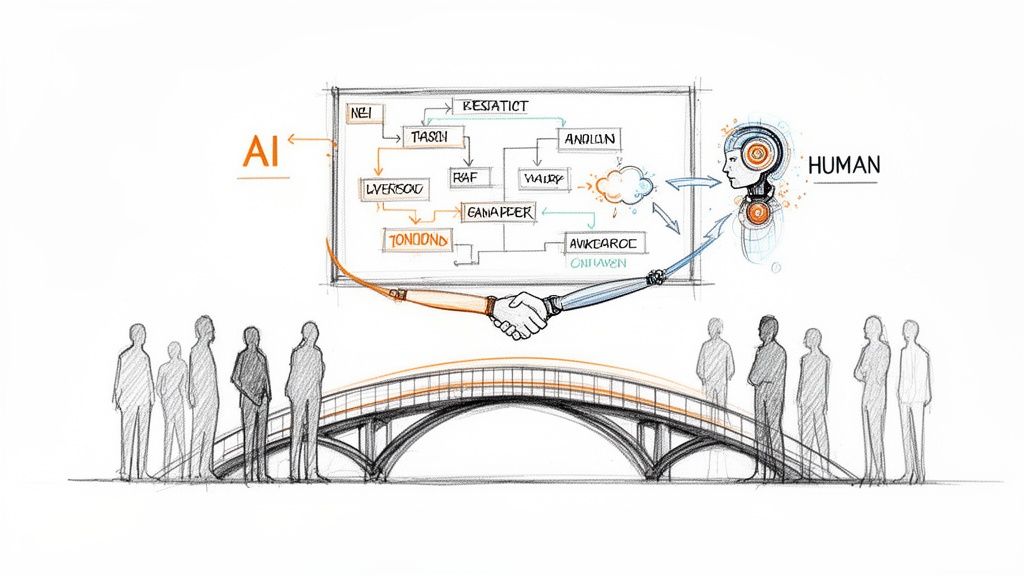
Let’s get one thing straight: this isn’t about robots replacing your team. It’s about giving your team superpowers. True social media automation forges a powerful partnership between human creativity and AI’s relentless efficiency. The goal isn't to phase people out, but to elevate them by offloading the repetitive, soul-crushing tasks to software.
Think of it like a world-class chef with a team of perfectly trained assistants. The assistants handle the chopping, measuring, and cleaning—all the tedious but essential prep work. This frees the chef to focus on what truly matters: inventing brilliant new recipes, perfecting flavors, and creating an unforgettable dining experience.
That’s the exact model for a successful hybrid team. Your human experts are the chefs, and AI tools are their indispensable assistants, working tirelessly in the background.
Defining Roles for a Hybrid Team
The secret to this powerful synergy is absolute clarity. You must draw a clear line: this is what the AI does, and this is what our people do. Blurring these lines creates chaos, but a clear structure unlocks incredible efficiency.
The best way to split the work is simple: logical, repetitive, data-driven tasks go to the AI. Creative, strategic, and empathetic work stays with the humans.
Your human team should never try to compete with AI on speed or data processing. Their job is to direct the AI, make sense of its findings, and use the incredible gift of reclaimed time to build the genuine relationships and brilliant ideas that actually drive growth.
This division ensures your most valuable resource—your team's brainpower—is spent on high-impact activities that automation simply cannot touch.
How to Structure Your Augmented Workflow
Building this synergy starts with an honest look at your current process. Where is your team getting bogged down? Once you identify the bottlenecks, you deploy AI to eliminate them.
Here’s a simple structure for a hybrid social media team:
AI's Role: The Doer
Content Scheduling: Manages the entire content calendar like an air traffic controller, pushing posts live at the perfect times across all platforms.
Data Analysis: Works 24/7 scanning performance metrics and compiling simple, easy-to-read reports on engagement, reach, and audience growth.
First-Level Engagement: Instantly handles common DMs and comments, like questions about store hours or shipping policies.
Trend Spotting: Monitors keywords and hashtags to flag emerging conversations, giving the human team a chance to jump in and look like geniuses.
Human's Role: The Strategist
Creative Direction: Develops the big campaign ideas, crafts compelling brand stories, and designs the stunning visuals that make people stop scrolling.
Community Building: Jumps into nuanced, high-level conversations, fosters relationships with key influencers, and handles sensitive customer feedback with empathy.
Strategic Planning: Uses the AI-generated reports to make brilliant decisions, fine-tune the content strategy, and set ambitious goals for the future.
Final Approval: Acts as the ultimate quality check, giving every AI-generated or scheduled post a final once-over to ensure it perfectly captures the brand’s voice and values.
This model creates a powerful feedback loop. The AI does the grunt work, freeing up your team to think bigger and act smarter. All the time they get back is poured directly into the creative and strategic efforts that set your brand apart, allowing a small team to achieve the results of a much larger one.
Your Step-by-Step Implementation Checklist
Ready to trade the daily grind for automated brilliance? This is your roadmap. Implementing automation isn't about flipping a giant switch; it's about taking deliberate, strategic steps. Let's walk through the exact process to get you from manual overload to automated efficiency.
Step 1: Audit Your Current Process
Before you can automate, you must know where your time is going. For one week, track every single social media task you perform. Be brutally honest. Log everything—from brainstorming post ideas and designing graphics to answering DMs and pulling metrics.
This audit is your treasure map. It will reveal the time-sucking black holes in your workflow. Are you spending an hour every day just copy-pasting content between platforms? Is your team stuck answering the same five questions a dozen times a day? These are your bottlenecks, and they are the first things you will automate. You can't improve what you don't measure.
Step 2: Define Your Automation Goals
"Saving time" is a great perk, but it's not a business goal. To make automation truly powerful, you must connect it to tangible outcomes. What does success actually look like?
Here are some examples of powerful, specific goals:
Goal: Drive 20% more qualified leads from LinkedIn this quarter.
Automation: Create a workflow that automatically shares new blog posts, case studies, and webinar invites to key company and employee profiles, with a clear call-to-action in each.
Goal: Reduce customer support response time on Facebook to under 15 minutes.
Automation: Set up an AI chatbot to instantly handle common inquiries ("Where is my order?") and route complex issues to a live agent.
When you set clear, measurable goals, you stop treating automation as a fun gadget and start using it as a serious growth engine. Every workflow you build will have a direct purpose.
Step 3: Choose Your Tools or Platform
Now that you know what you want to achieve, it's time to pick your weapons. The market is full of options, from simple schedulers to sophisticated, all-in-one AI platforms. Your choice should be driven by your goals, your budget, and the specific problems you're trying to solve.
Look for tools that can grow with you. If customer support is your biggest pain point, you'll want a tool built for engagement. It can be incredibly helpful to see how different platforms stack up, so you might want to explore the best Gorgias alternatives to find a solution that fits your team perfectly. The right software should feel like a trusted partner that makes your life easier, not another complicated system to manage.
Step 4: Build Your First Automated Workflows
Here’s the secret: start small to win big. The biggest mistake people make is trying to automate everything at once. That's a surefire recipe for overwhelm. Instead, pick one or two of the most repetitive, mind-numbing tasks from your audit and automate those first.
Content scheduling is often the perfect place to start. For example, build a simple workflow that automatically shares your latest blog post across all your social channels. Once that's running smoothly, you have an immediate win. Next, you could tackle auto-replies for common DMs. Each small, successful automation builds momentum and frees up more of your time, making the entire process feel exciting and achievable.
Common Questions About Automation
Jumping into social media automation usually brings up a handful of good questions. It's totally normal to wonder how this will affect your brand's personality and, of course, your budget. Let's tackle some of the most common worries to help you get started with confidence.
The biggest fear I hear is that automation will make a brand sound cold or robotic. It’s a fair point, but it's usually based on an outdated idea of what automation actually does.
The goal isn’t to fake human connection—it’s to clear away the tedious tasks that prevent you from having time for it. Think of automation as your brand's backstage crew. They handle the lights and sound (scheduling posts, pulling reports) so your team—the stars of the show—can be present and engage with the audience when it matters most.
You’re still the director. You write the script, define the brand voice, and set the strategy. The automation simply makes sure your message gets delivered consistently, freeing you up for the meaningful conversations that build a real community.
Will My Brand Sound Like a Robot?
Not if you do it right. Good social media automation actually makes you sound more human and consistent, not less. For example, you can create a bank of pre-approved, on-brand replies that an AI uses for common questions. This ensures your brand voice is perfect every time while delivering instant, helpful answers.
By automating the simple "What are your hours?" questions, your team can save their creative energy for the nuanced, high-value interactions that build customer loyalty and define your brand.
How Do I Pick the Right Tools for a Small Business?
For a small business, the best tool is the one that solves your biggest headache without adding complexity. Don't get distracted by platforms with a million features you'll never use. First, identify your biggest pain point.
Struggling to post consistently? A straightforward scheduling tool like Buffer or Later is a perfect, low-cost starting point.
Drowning in DMs? Look for a tool with a unified inbox that can help you sort and prioritize messages.
Running out of content ideas? An AI-powered content generator can be a game-changer for brainstorming and drafting posts when you feel stuck.
The trick is to start small. Solve one problem at a time and choose tools that offer free trials. Test them out and see what feels like it’s actually making your life easier.
How Do I Measure the ROI of Automation?
Knowing if your investment is paying off is critical. The most immediate metric is time saved. Calculate the hours your team gets back each week and multiply that by their hourly cost. That number is your instant financial return.
But don't stop there. Track how automation impacts your key performance indicators (KPIs). Look for a direct lift in:
Engagement Rate: Are more people liking, commenting, and sharing now that you're posting great content consistently?
Website Clicks: Are your automated posts driving more traffic to your site?
Lead Generation: Are you capturing more leads through automated comment replies or smarter DM conversations?
When you connect automation to these core business goals, its value becomes undeniable. For more ideas on marketing strategies, you can find other articles on our blog.
Ready to stop the manual grind? Dooza is an AI-native company that builds AI products and services for small businesses. Somi, our social media AI employee, works alongside your human team. Start with a refundable pilot — 100% refund within 14 days.
Claude Opus 5.5: Fable-Level Performance at 40% Lower Cost, Explained
Anthropic's Claude Opus 5.5 is the first model in the Claude 5.5 family. It performs at roughly the level of Claude Fable 5.1 on most work, costs 40% less to run than Opus 5, and generates output more than 30% faster. Here is what changed, how to choose between Opus 5.5, Fable 5.1 and Sonnet 5.5, and what it means for businesses running AI agents.
Claude Made a Video on Western Civilization: How AI Explainer Videos Work
A two-minute animated video on Western civilization, which its poster says Claude made, reached 15 million views on X. Here is what we can verify about how it was made, how code-rendered AI explainer videos work, why it went viral, the criticism, and practical ways small businesses can use AI video.
Start with a refundable pilot — 100% refund within 14 days. A Dooza engineer scopes it with you on a free 30-minute call. Pricing depends on the product; see pricing.